
HCSL Software Repository
DiagAccU
Chatzimichail RA, Chatzimichail T, Hatjimihail AT. DiagAccU: A unified framework for uncertainty estimation of diagnostic accuracy measures. Ver. 2.0.1. Hellenic Complex Systems Laboratory; 2026.
Software Synopsis
DiagAccU implements a computational framework for quantifying the sampling, propagated measurement, and combined standard uncertainties of sixteen diagnostic accuracy measures and provides approximate pointwise expanded-uncertainty intervals. Normal, lognormal, or gamma distributions are specified separately for the diseased and nondiseased populations, allowing nine distributional combinations. Sampling uncertainty incorporates the covariance between the estimated mean and standard deviation within each population and, when enabled, prevalence uncertainty estimated under a binomial cohort-sampling model. The specified diagnostic threshold is held fixed. Measurement uncertainty is specified by a linear or root-sum-of-squares model with constant and proportional coefficients. Joint propagation retains the nonpositive measurement covariance between sensitivity and specificity arising from their opposite-signed sensitivity coefficients. Under the assumed independence of sampling and measurement sources, their propagated variance contributions are added; combined standard uncertainty is the nonnegative square root of this sum. At specified thresholds, uncertainty is propagated using a first-order Taylor approximation. By default, expanded-uncertainty intervals use Student’s t coverage factors with approximate Welch–Satterthwaite effective degrees of freedom calculated from source-specific variance contributions. Optimal thresholds for nine measures are estimated by numerical maximization over thresholds greater than the estimated nondiseased mean. At each estimated optimal threshold, first-order sampling variance is added to the measurement variance evaluated by nine-point Gauss–Hermite quadrature, with numerical evaluation nodes centred at the fixed selected threshold and scaled by the specified measurement standard uncertainty. The resulting uncertainties and intervals concern the diagnostic accuracy measures conditional on the estimated optimal thresholds; they exclude optimal threshold uncertainty arising from estimation and selection. The program provides interactive plots, comprehensive tables, and joint covariance outputs to support evaluation of diagnostic thresholds, including candidate confirmatory and exclusionary thresholds; transparent uncertainty reporting; sensitivity analyses across distributional and measurement assumptions; and study-design exploration.
Snapshot
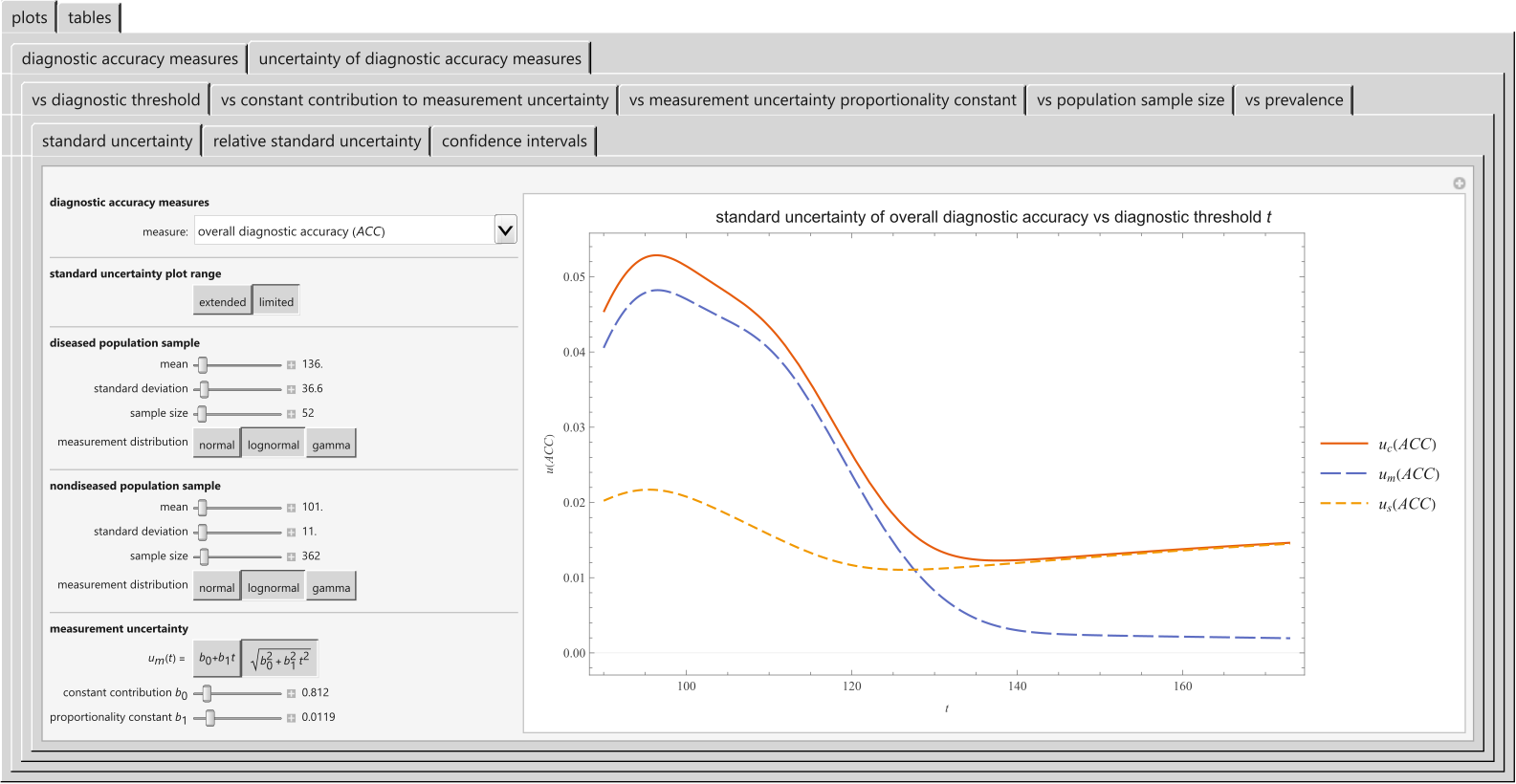
Source Notebook (Revised on 2026-09-19)
Software Requirements
Operating systems: Microsoft Windows, Linux, Apple macOS and iOS
Programming language: Wolfram Language
Source file format: Wolfram Notebook
Other software requirements: Wolfram Player (freely available) or Wolfram Mathematica
Recommended system: Intel Core i9 or equivalent CPU and 32 GB+ of RAM
Project Status
Active
Terms of Use
The material made freely available by Hellenic Complex Systems Laboratory is subject to its Terms of Use.